
Behind Two Proprietary Technologies Native to Kershaw Knives
Posted by River's Edge Cutlery on 21st Aug 2026
Kershaw Knives are among the most popular in the industry, and their folders are particularly popular for EDC. Models like the Kershaw Leek and Blur have loyal followings and the brand is highly respected among knife enthusiasts.
The company is also a pioneering influence in the knife industry, and has developed and then introduced several pivotal technologies that have been very well received and which have themselves improved safety and performance where they have been implemented.
Two of the most well-known of these are SpeedSafe Assisted Opening Technology and Composite Blade Technology, at which we will take a closer look in this article.
SpeedSafe Assisted Opening Technology
SpeedSafe Assisted Opening Technology is a proprietary Kershaw technology that is intended to assist with the opening of select folding knives, safely, quickly, and efficiently, with a short learning curve. This technology (in Kershaw Knives, at least) was pioneered by Ken Onion in the late nineties, and most other assisted opening knives that followed basically took the same mechanism and adopted or adapted it.
Inside each knife equipped with this technology is an L-shaped (usually) torsion spring which, on one end, corresponds to a channel in the knife frame, and on the other, towards the blade, fits into a roughly U-shaped channel near the base of the blade, near the pivot mechanism.
When the knife is closed, the torsion spring (or torsion bar, if you will) is partially compressed and helps hold the blade closed. When the knife is opened part of the way, the one end of the torsion spring nearest the blade slides along the U-shaped cutout until it slips past a certain point and springs forward.
This action completes the opening of the blade, and the lock takes over the rest, securing the blade in place.
SpeedSafe assisted opening is not just easy to use, it is reliable, fast, and does not require any effort from the user besides the engagement of a flipper tab or thumb stud. The torsion spring completes the rest of the work, improving the reliability and safety of deployment.
This technology also makes it easier for users that are not skilled with flipper tabs or other deployment mechanisms to reliably open their knives with one hand. It takes a good bit of practice to get proficient with thumb studs or flipper tabs to open a knife without an assist mechanism completely, and Kershaw’s SpeedSafe Assisted Opening Technology has proven a game changer on that front.
Composite Blade Technology
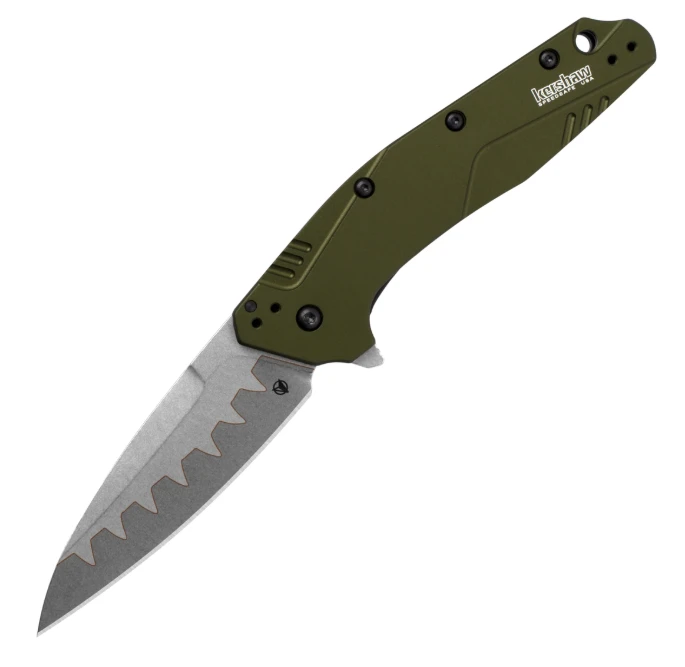
Kershaw Knives also introduced something they call Composite Blade Technology to the world, which is another value-added feature of the knives that feature it.
Kershaw’s Composite Blade, in knives that have it, effectively combines two steel alloys into one blade using an extremely strong brazed joint.
It is similar to but not exactly the same as the differential temper used by traditional Japanese swordsmiths to produce a harder edge and a softer, more abuse resistant spine. Indeed, the wavy line near the edge of a Kershaw knife with Composite Blade Technology is reminiscent of the hamon line of traditional Japanese blades, produced by yaki-ire, or clay tempering, which produces the differential temper.
Or, perhaps, it is most helpful to think of Kershaw’s Composite Blade Technology as something similar to san mai, another Japanese process wherein two different steel alloys are combined into one blade stock, with a softer, more resilient core and spine and a harder, more wear-resistant outer layer that exhibits better edge retention.
To make more material sense of Kershaw’s Composite Blade Technology, however, we will look at a concrete example, the Dividend with a Composite Blade, which sports a spine of N690 joined to a D2 cutting edge.
This technology marries the strengths of both alloys into one blade. The D2 steel edge exhibits a high carbide concentration for good edge retention, but it is considered a relatively low toughness steel. That’s where the N690 spine comes in; it is considered a fairly tough steel that is not likely to chip or shatter under stress.
Pairing two alloys like these is a game changer because, as in the case of the differential temper of traditional Japanese swords, you get a very hard edge that stays sharp for longer, but overall blade stock that is tempered by the strength and resistance of the softer, more abuse-tolerant spine.
In other words, a knife that is hard without being too brittle.
Explore Kershaw Knives Here
SpeedSafe Assisted Opening and Composite Blade Technology are only two of the unique strides Kershaw Knives have made, but they are among the best known and the most impactful, especially in the case of assisted opening, as that was revolutionary in the industry.
Needless to say, technologies like these are only some of the many reasons that Kershaw Knives are so popular. Explore our full collection here and get in touch with us if you have any questions or need a recommendation.