
Different Folding Lock Types: Advantages and Disadvantages
Posted by River's Edge Cutlery on 1st Oct 2026
While some folding knives are friction folders or slipjoint knives, which lack locks, the majority of single-blade folding knives on the market today have locking mechanisms. This makes them much more appropriate to handle jobs traditionally reserved for fixed blade knives than their non-locking counterparts.
With that being said, there are many, many different types of folding knife lock types out there. We will cover some of the more common ones here. Take this as your primer and if you have specific questions after reading, contact us directly.
Liner Lock
Liner locks are among the most common of all folding knife locks, not only because they are simple by design, but because they are relatively affordable to produce.
In a knife with a liner lock, one of the knife liners is tempered so that it springs inward and wedges under the base of the knife blade when the blade is open. It engages automatically and to disengage it, the user must press the liner back to the side of the knife so that the blade can close.
Advantages of liner locks:
- Affordable to manufacture.
- Easy to learn to use.
- Easy to disengage.
- Can be disengaged with one hand.
Disadvantages of liner locks:
- They tend to favor right handed users.
- The lock can unintentionally disengage.
- To disengage, you need to put your fingers in the path of the blade.
Frame Lock
The principle of operation of a frame lock is the same as a liner lock, except that, instead of the liner within the knife handle serving as the lock, the entire side (frame) of the knife is tempered so as to spring inward, wedging under the blade and locking it open when the blade is deployed.
Advantages of frame locks:
- Frame locks can be engaged and disengaged with one hand.
- They’re easy to use.
- They’re stronger than liner locks.
Disadvantages of frame locks:
- They require you to put your fingers in the path of the blade when closing (as do liners locks).
- Like liner locks, they are designed for either a right-handed or left-handed user (usually right-handed).
Lock Back
The lock back mechanism, popularized by the Buck 110 Folding Hunter, is another popular folding knife lock.
In a lock back (also called a back lock), there is a rocker arm that pivots around a pin, with a lug that engages a notch in the base of the blade when the knife is open. To disengage the knife, a bar at the back (hence the name) of the knife must be depressed, which lifts the lock bar’s lug away from the blade so that it can rotate.
Advantages of lock backs:
- Very strong.
- Easy to use.
- You don’t need to put your fingers in the path of the blade when closing.
Disadvantages of lock backs:
- Usually you need both hands to close the blade.
Crossbar Lock (AKA AXIS-Style Lock)
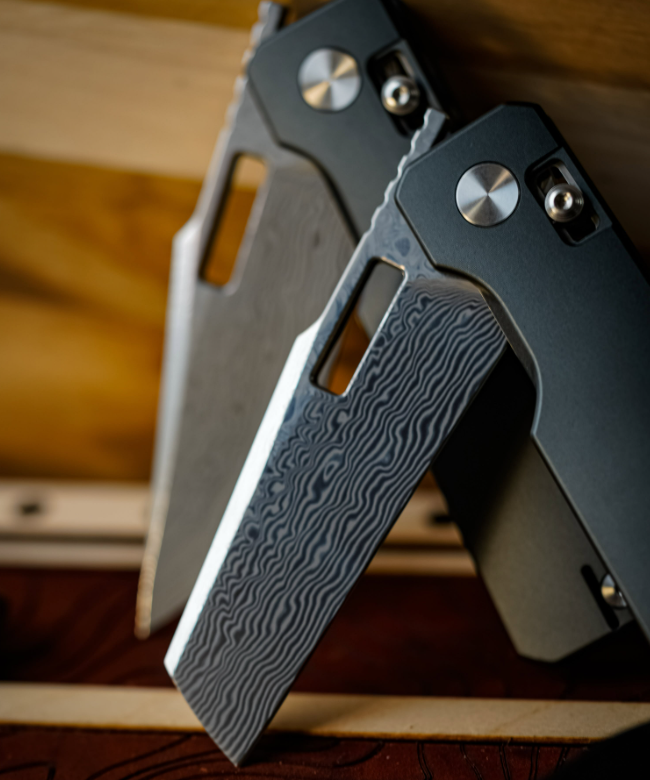
The crossbar style lock, pioneered by Benchmade Knives in the AXIS Lock, consists of a cylindrical bar that rides between the scales and frame of the knife, near the blade, and which is held under tension by a U or Ω-shaped spring.
When the knife is closed, the spring and bar serve as a detent; when it is opened the spring is depressed, allowing the bar to slide forward into a recess in the base of the blade, locking it open.
Advantages of crossbar locks:
- Very strong.
- They do not favor either right or left-handed users.
- They can be disengaged with one hand.
- You can keep your fingers out of the path of the blade when closing.
- The crossbar lock can be self-adjusting for wear, preventing play from developing.
Disadvantages of crossbar locks:
- Not as intuitive to users that might not be familiar with them.
- When the spring fatigues, it will need to be replaced or the lock will not function.
Button Locks
In a knife with a button lock, there is a cutout in the blade tang that corresponds to a button set in the knife handle that is held under tension by a spring. When the knife is opened, the button engages the cutout and locks the blade open. To close a button lock all you need to do is depress the button and fold the knife.
Advantages of button locks:
- They are extremely easy to engage and disengage with one hand.
- You can keep your fingers out of the blade’s path when closing.
Disadvantages of button locks:
- Due to their complexity they can be subject to dirt and grime causing unreliability.
Compression Locks
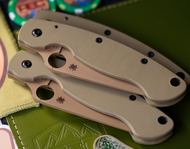
Compression locks, featured on some Spyderco knives, consist of a leaf spring cut from the liner, but at the back of the knife, rather than under the front of the blade, as in the case of a liner lock. The lead spring engages a cutout on the base of the blade, but is wedged in place with a stop pin that prevents the liner from disengaging except through an intentional act.
Advantages of compression locks found on Spyderco knives:
- They are extremely strong, among the strongest of all folding knife lock types.
- They’re relatively easy to learn to use.
- You can keep your fingers out of the blade’s path when closing.
Disadvantages of compression locks:
- Not particularly common; mostly found on Spyderco knives.
- Can be a little awkward for left-handed users.
Explore Folding Knives Here
Looking for a new folding knife? Check out our collection of knives from the top brands; we carry Benchmade, Microtech, Chris Reeves and Spyderco knives, among others. Get familiar with what we offer here and contact us if you have any questions or need a recommendation.