
What You Need to Know About How Throwing Knives Are Different
Posted by River's Edge Cutlery on 29th Aug 2026
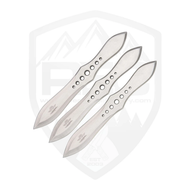
Throwing knives are, as the name suggests, not only intended to be thrown, but designed for that express application.
And, while you could technically throw any knife, that is highly inadvisable. You’ll break any folder’s lock eventually by throwing it, and most fixed blades, for one reason or another having to do with balance, blade temper, or some other feature, are not well-suited to be used as throwing knives.
So, that being the case, let’s look at some of the primary attributes that make a quality throwing knife.
Heat Treatment and Blade Temper
The Rockwell Hardness scale is the one most often used to qualify how hard a blade’s edge is, and thereby how long it will last before the knife needs to be resharpened.
By and large, a harder rating is generally desired for most knives because, the harder the knife is, the less frequently it will need to be resharpened. This is a generalization but it usually holds water.
To put things in perspective, swords and daggers typically have lower hardness ratings than knives because they are used as striking weapons, and so have to be more tolerant of impact than knives used for cutting and general utility.
Either that, or in the case of some swords such as Japanese sword patterns, they are treated with a differential temper, wherein the spine is softer and more shock-resistant, and the edge is harder.
The same conditions apply to throwing knives, even though they are fundamentally very different from swords.
Most throwing knives are heat treated to a relatively low hardness rating, typically around 50 to 54 on the Rockwell scale. Many other fixed and folding knives are much harder, between 56 and 60 on the same scale.
The reason for this lower hardness is that throwing knives must by their nature be able to absorb the forces of impact associated with throwing. If you threw most fixed blade knives at a target, at a certain point, you’d likely snap the tip or just shatter the blade.
Moreover, the softer hardness rating is hardly a detriment to edge retention because many throwing knives have dull edges or no true edges whatsoever, since they don’t need them. In some cases, a sharpened edge is actually a drawback because it poses a risk of laceration to the thrower.
The softer ratings of throwing knives make it possible for them to withstand the impulse and forces of impact so that they last longer and you deal with fewer broken blades.
This alone makes an investment in actual throwing knives worth it if you intend to get into knife throwing. “Regular” fixed blade knives just can’t shoulder the abuse.
Lack of Scales
If you look at the throwing knives for sale on our website, you will see that pretty much every pattern lacks scales.
This is because scales are not only useless on throwing knives (there’s no need for traction on a handle that you’re not gripping for cutting if you grip it at all) but scales would interfere with balance.
The inclusion of scales on a throwing knife would almost necessarily shift the point of balance further back towards the tang, which in turn would ruin the flight of the throwing knife.
So, most throwing knives (if not all) lack scales, or only have lightweight scales that are there to fine tune the balance or offer some other aesthetic appeal.
Balance
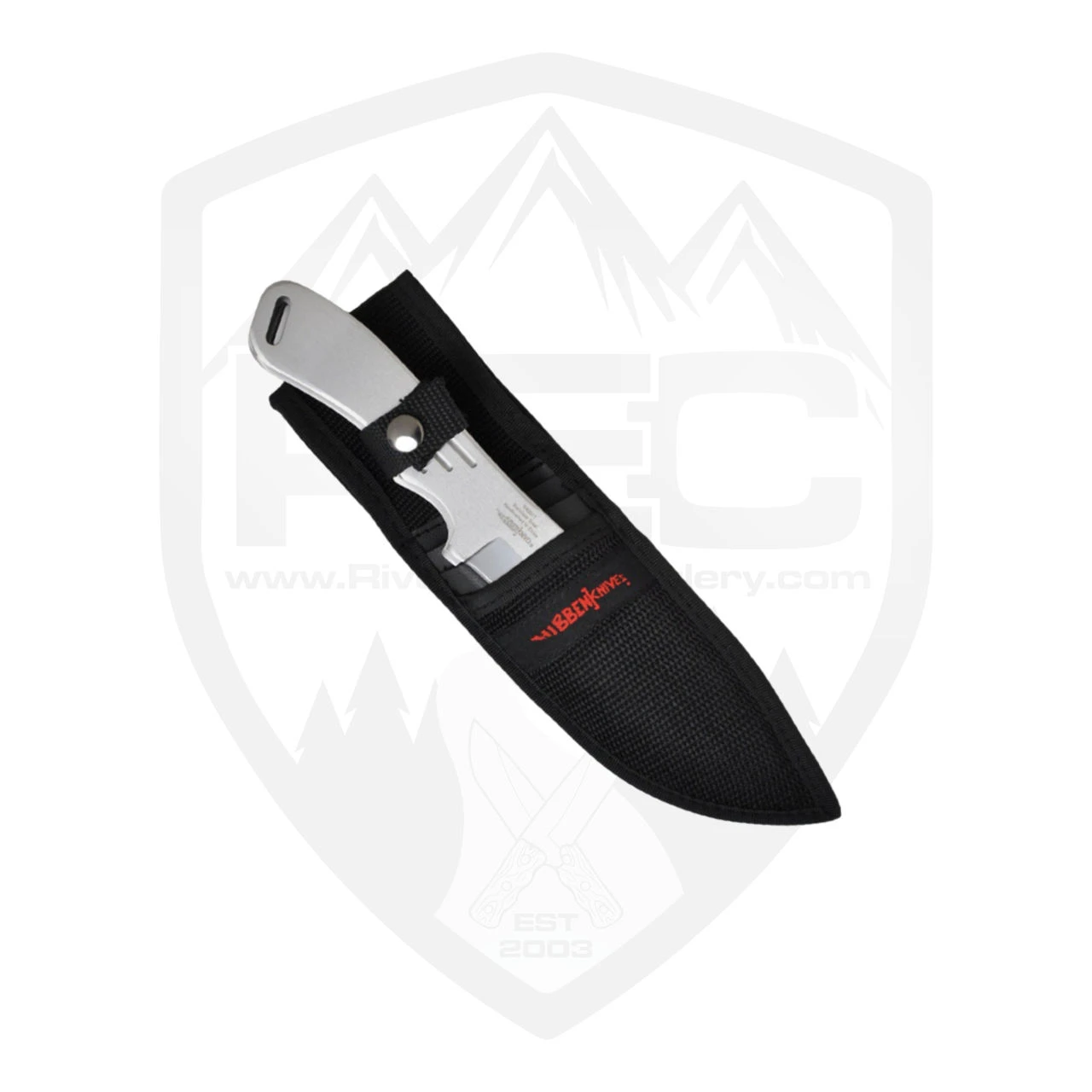
Lastly, and equally as important as the temper of the throwing knife, is the balance. Throwing knives are specifically and precisely engineered to offer consistent balance that enables them to fly straight, whether the thrower in question prefers to throw them point-toward the target, or throw them so they rotate.
Both are popular techniques but regardless, they require a knife that is well-balanced and therefore offers repeatable results.
Where the throwing knife’s balance point lies is a matter specific to each model, but in most cases, the balance point will be exactly at the middle point of the knife. This helps to keep the knife stable whether it is thrown point on or rotated.
However, some throwing knives, especially those that are thrown point-forward, have a center of mass that is concentrated towards the tip of the blade. This helps stabilize the knife and pull the tip forward as it moves toward the target.
Shop Throwing Knives Here
In the market for a dedicated set of throwing knives that you can use for training, practice or even for competition? Check out our full collection which represents top brands in throwers, such as Gil Hibben, Cold Steel, Spyderco Knives and others, and if you have any questions about what throwing knives might be best for you, or need a recommendation, get in touch with us directly and we will be more than happy to help.